

Yeah, the Chinese are terribly imaginative. They're not entrepreneurial. They don't innovate. When former Hewlett-Packard CEO Carly Fiorina made the above claim in 2015, she echoed the Western business world's assumption that imitation rather than imagination has fueled China's rise. More than a decade later, reports from the Australian Strategic Policy Institute show that China leads in 57 out of 64 critical global technologies, while the 2025 Global Innovation Index ranks the country firmly among the world's top ten.How did China, once labeled an imitator, manage to engineer such an innovation comeback?
Addressing this question, ZIBS Assistant Professor Fayaz Ahmad Sheikh and Prof Xiaobo Wu published an insight article titled Decoding China's Innovation Black Box: How Learning, Constraint, and Chaos Drive Creativity in the California Management Review. Drawing on China's industrial practices, the article systematically unpacks the underlying logic of China's innovation model, offering a fresh perspective for understanding the country's rise in innovation and enriching global innovation theory.
Screenshot of article publication
Four Key Drivers Behind China's Innovation Rise
By examining a wide range of industrial practices and market cases, the insight piece finds that China's rise in innovation is far from accidental. Instead, it is driven by the interaction of four distinctive developmental conditions. Together, these four forces form the foundation of China's innovation model and distinguish it from Western approaches to innovation.
The Latecomer Advantage of Iterative Learning
As a late-developing economy, China did not need to repeat the lengthy process of starting innovation from scratch. Instead, Chinese firms built upon globally mature technologies and business models, achieving secondary innovation through absorption, adaptation, and iterative reconstruction.
For example, in the early stages of the new energy vehicle industry, Chinese automakers drew on established automotive systems while continuously refining them to suit domestic road conditions, consumer demands, and smart ecosystems. This process ultimately enabled breakthroughs in areas such as battery technology and intelligent cockpit systems.
Through this learn–optimize–upgrade pathway, Chinese industries have been able to catch up efficiently and rapidly narrow the technological gap with developed economies.
Constraint-Driven Innovation Under Resource Limitations
Unlike Western economies with abundant research resources, China's industrial development has long faced periodic constraints in capital, technology, and high-end talent. These limitations pushed firms away from extensive, high-cost innovation models and toward solutions that emphasize practicality, efficiency, and cost-effectiveness.
A typical example can be found in the early development of China's home appliance and consumer electronics industries. Faced with limited technology and budgets, domestic firms abandoned redundant high-end features and instead focused on highly adaptable, value-for-money solutions. Through continuous iteration, they developed products better suited to mass-market needs, giving rise to a distinctive model of constraint-driven innovation.
The Grassroots Vitality of a Massive Market
Backed by the advantages of a vast domestic market, China's innovation model has broken away from the elite- and laboratory-centered approach often seen in the West. Small and medium-sized enterprises, entrepreneurs, and ordinary consumers all participate in product iteration and business-model optimization, creating a bottom-up, distributed innovation ecosystem.
Shenzhen's hardware startup scene, the rise of new e-commerce models, and the rapid evolution of short-video-driven local lifestyle services are all representative examples. Through constant experimentation and incremental innovation driven by real-time market feedback, countless smaller players have enabled innovation to penetrate every layer of industry, continuously unleashing enormous economic vitality.
An Open Ecosystem Enabled by Full-Chain Collaboration
China's comprehensive industrial supply chain has created a natural advantage for collaborative innovation. Moving beyond closed-door R&D models, market players engage in cross-company and cross-industry coordination, integrating resources and working together to accelerate technological experimentation and commercialization.
The smartphone industry offers a clear example. From component supply and contract manufacturing to algorithm adaptation and application ecosystem development, upstream and downstream firms collaborate efficiently and complement one another throughout the value chain. Supported by this open and coordinated industrial ecosystem, China has been able to continuously amplify its overall innovation efficiency.
The DSIS Model: Decoding the Core Logic of China's Innovation System
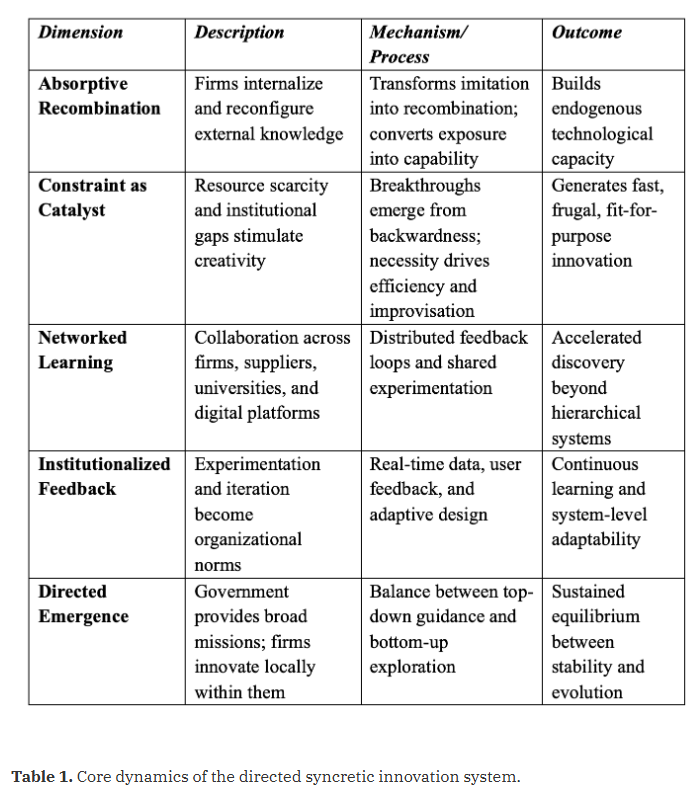
Departing from the traditional linear model of innovation centered on isolated R&D, the study finds that China's innovation system follows the DSIS (Directed Syncretic Innovation System) model — a dynamic system that continuously evolves through learning and feedback loops.
Driven by strong capabilities in knowledge absorption and recombination, industries are able to move from borrowing external technologies to building indigenous capabilities. At the same time, unlike resource-driven innovation paradigms, constraints in resources, markets, and institutions have not hindered industrial development. Instead, they have pushed firms to create innovations that are low-cost, highly adaptable, and strongly application-oriented.
Meanwhile, distributed industrial-network collaboration breaks through hierarchical barriers and significantly accelerates the pace of innovation iteration. A normalized trial-and-error feedback mechanism allows products and business models to be continuously refined through real-world implementation, enabling them to respond precisely to shifting market demands.
Ultimately, the system forms a distinctive order that combines state-directed guidance with market-driven exploration, establishing the underlying logic of China's innovation model.
Innovation Does Not Have a Single Formula
For a long time, global discourse and evaluation standards of innovation have been largely defined by Western models that emphasize from-scratch originality and heavy resource investment. However, this study offers a different perspective: there is never a single standard answer to innovation.
Leveraging their own development endowments, late-developing economies can also chart distinct paths of innovation-driven catch-up through continuous learning and iteration, constraint-induced breakthroughs, and collaborative industrial ecosystems.
The practical experience of China's innovation journey not only reshapes external perceptions of China's innovative capacity, but also provides new developmental insights for many emerging economies. In doing so, it contributes to a more diverse and multidimensional global innovation landscape.